Trusted Adviser in Information Technology & Business with a focus on Native American success. IBMer, Tribal Business Expert, STEM Educator, and Fly-fisher!
Here is a very good microphone placement technique I learned years ago for recording audio interviews and corporate educational materials. Some people have called this the “Hat Mic” or “Hat (Mic) Trick” technique. I’m posting this so more people can learn this great miking technique.
It involves is clipping a lavalier/lapel microphone to the brim of a baseball cap as shown here:
Then putting on the hat mic and running the microphone cable behind a ear and to the recorder or computer mic port.
This miking technique has several advantages. The most important ones are a constant fixed distance between the speaker’s mouth and the microphone (really helps with setting gain levels) and the microphone is out of the breath path of the person speaking (removes breathing on the mic and plosives).
Here is a MP3 audio example of the the hat mic technique in action.
When I record audio interviews, I usually choose between 2 hardware setups depending on the situation.
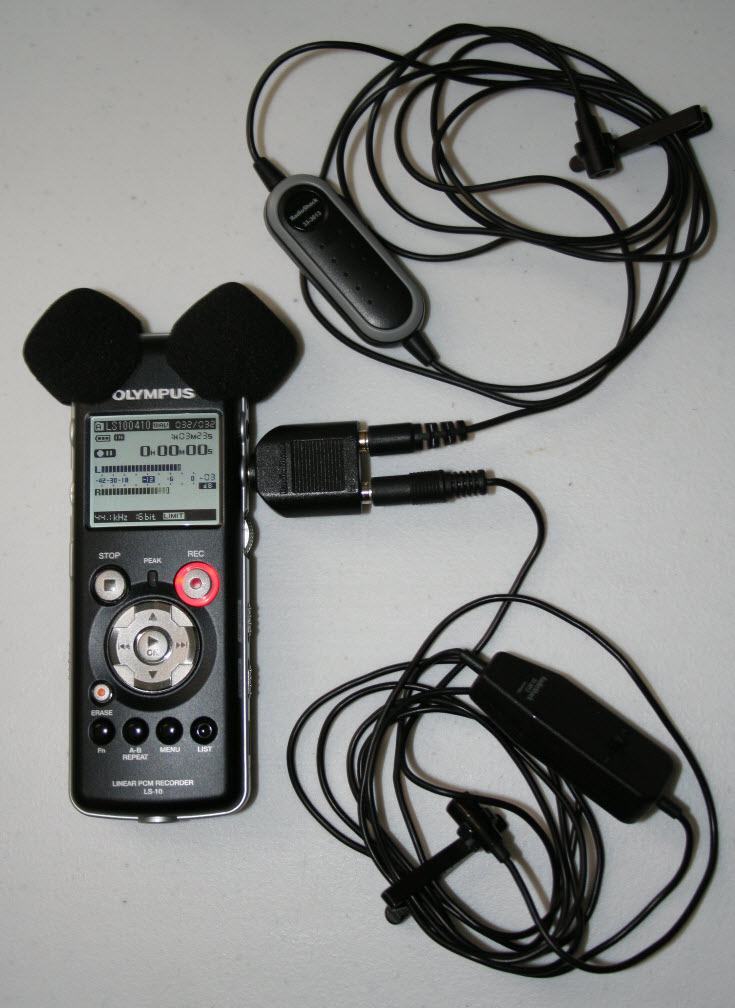
The first setup is for ultra-light portable field recording without any power nearby or audio mixer to plug into. This comprises primarily of a Olympus LS-10 digital audio recorder, 2 lavalier/lapel wired microphones with 1/8 mono connectors, and a Y connector which connects each mono connector to the right or left stereo input on the LS-10. Click on the image to see a larger version.
The second setup is also for field recording that gives me more options to either plug into an existing audio mixer, or use higher quality phantom powered wired or wireless microphones. It’s made up of a Marantz PMD661 digital audio recorder and paired with a couple Shure Beta58A microphones (as pictured) or a couple Shure PGX wireless lavalier/lapel microphones (these require AC power nearby).
One of the more important points about recording interviews is microphone placement. I prefer to use the lavalier/lapel microphones when I can because it allows me to place the microphone at a consistent distance from the mouth of the person talking and there is little chance for handling noise. With hand-held microphones, moving of the hand on the surface of the mic can cause audio noise to be picked up by the recorder.
One tip on using the devices, the Olympus LS-10 can be setup to use Auto-Gain or Fixed-Gain, the gain applies to BOTH left and right channels at the same time, there is no individual gain for each channel. On the Marantz PMD661, each channel has it’s own gain and can be adjusted independently depending on the person’s speaking volume.
Once I am done with the recording, I take the WAV file from either recorder, run the file through the Levelator, and edit them using Audacity (remove parts I don’t want). Once all the editing it done, the audio is then rendered (or produced) into MP3 format.
Below is a video I made of the production process using Audacity & the Levelator (the audio used was recorded using the Olympus LS-10 setup):
In my life journey so far, I benefited from several native individuals who helped guide me at different points in my life.
These were in-person conversations where ideas were exchanged and advice was given on “what to watch out for” or “nuggets of knowledge” based on experience & wisdom from being there before.
With the power of the internet & time-shifted learning, we now have a opportunity to share our “native professional story” with many more native youth than talking to each individually.
Now that I’m back in Albuquerque, and among more native professionals, I’m going to interview and collect the success and failure stories of today’s native professionals, leaders, and business owners. I strongly believe that the things we did wrong (failures) are just as important as the things we did right (success).
I’ve decided to create a new category on this Blog to highlight this effort, so now on the left side you will see “A Native Professional Story” link and be able to click it to see the latest interviews available. As more individuals are interviewed a page will be created to house the list and their areas of knowledge and expertise.
First on the list is of Dr George Blue Spruce Jr, a person who dealt with adversity, attained success on many levels, and wrote a book.
I will also be doing a self interview soon, I just need to work out all the questions I want to ask myself and others in the future.
I’m also open to any question suggestions.
This should be a very interesting and fun project to document the stories so the native youth can learn from what the native professionals, leaders, & business owners have learned.
I recently found the Harvard Business Review IdeaCast on iTunes. I came across a informative podcast called “Avoid These Career-Planning Fallacies” that talked about career paths of managers and executives, about 15 minutes long. In particular it was interesting to hear about the topics of job hopping, promotions, and international experience. For those looking for career insight, this is a great episode. I have added this channel to my podcast listening list on my iPhone. Here is the direct link to the blog where the audio is, enjoy!




 Dominic Pruitt